
Here’s what you need for a good retirement: Health. Enough money. A safe place. And curiosity. Yes, curiosity.
You probably thought I was going to say friends, but I think friends follow from curiosity. If you’re curious, you get out, meet people, and ask them questions. That’s how you make friends.
Curiosity is the thing that keeps us engaged, keeps our world from shrinking. It drives us to learn more, see more, do more. It keeps us alive.
Without it, we just let the world come to us, letting it tell us what it wants us to think. With it, you head out into the world, see things, and meet people.
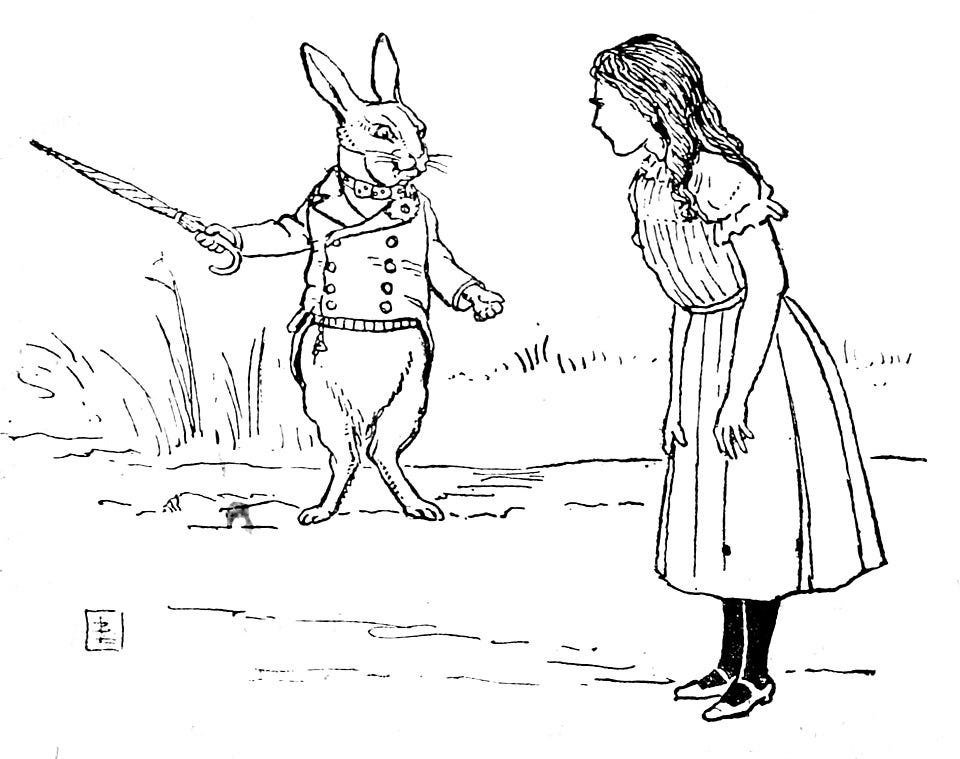
Curiosity isn’t a commodity like money or food. You don’t run out of it. If you ask questions or explore ideas, there’s always something more to learn, something you still don’t understand. Curiosity grows if you cultivate it. It multiplies. Like rabbits. What did Alice say when she fell down her rabbit hole? “Curioser and curioser!”
If you start wondering about something and indulge your curiosity, it leads to other questions, and you keep going. Or you can tell yourself you don’t have time for that or that it’s not important. If you always choose to always focus on the practical and move on, your curiosity withers away.
A well-tended curiosity manifests in many ways.
I Want to See the Bright Lights Tonight
I went to a Richard Thompson concert the other day with a friend, and he ran into a woman he knew while we were walking to the venue. She mentioned that she’d never seen Thompson and didn’t know his stuff, but decided to come out because she’d heard some other folks talking about him.
That kind of floored me. It takes a lot to get people off their couches and into an event, even if it’s free. And my guess is that just about everyone at that show had seen Thompson before. Probably multiple times. Who pays for a ticket to go alone to see someone they aren’t familiar with? Maybe as a teenager or in my early twenties, I might drop into a club for some band I’d heard about around town. It’s been forever since I did that. But this woman, not young, followed her curiosity out her front door and down to the ticket booth, where she shelled out good money for an artist she hadn’t heard.
I’m really jealous of her sense of adventure. Lately, my curiosity has turned inward, and I’ve focused on a way to grow it within structure. When I was writing my novel, I developed a habit of working daily on personal long-term goals. As I’ve found things I wanted to learn about, I’ve tried to build a structure around those ideas and devote time to them regularly. Slowly, I’ve added new topics. The other day, I pulled together the list of stuff I’m working through, and thought, “Hey, congratulations! I’ve invented school! I created my own damned college curriculum.”
The University of Me
It all came together in a haphazard way, but it has gelled around my interests. It’s all stuff from different sources and in different media, but it feels coherent to me. The whole amalgam of courses is costing around $200, but much of it involves books that were already on my shelf, saving me a few bucks.
I miss the social aspect of a classroom. Also, the dark sarcasm in the classroom, but none of the adult learning programs I’ve found nearly interest me. So here’s what I’m learning:
German 101: With Austria and Germany in the sights for retirement, this obvious choice approaches a necessity. There are lots of resources online for learning languages, but I subscribed to the Great Courses platform and am taking the Learning German: A Journey through Language and Culture course. The instructor is James Phrem is an Ithaca College German professor. I like to imagine him across the valley from my alma mater, trudging through the snow on a cold February day. Like all Great Courses programs, the info is presented efficiently and without too much fuss. There’s some effort to make it fun, but it’s clearly just his college course recorded on a cheap set. I bought the associated workbook as well and read along with each class. I watch each lesson multiple times, and it eventually sinks in.
I like the Great Courses platform quite a bit. Decades ago, I had a multiple CD set from them about how to build good sentences, and it rode around with me in my car for years, getting recycled constantly. It was the closest thing to a creative writing class I’ve ever had and helped build my confidence as a writer. We subscribe to the platform and dip in and out of stuff fairly often.
We also watch a fun series on YouTube, Easy German. They have a more rigorous paid program, but the YouTube series is a nice complement to the classroom stuff I’m getting from the Great Courses.
The History of Rock Music [and the 20th century] in 500 songs by Andrew Hickey. This absurdly ambitious podcast starts with Benny Goodman’s Flying Home in 1938 and ranges forward and backward across genres and fields of study in flabbergasting ways.
I’m currently listening to the episode on the Beach Boys’ Good Vibrations. It’s over 80 minutes long, and the first fifty minutes are spent on the myth of Orpheus, the Russian Revolution, and 20th-century avant-garde composers. All of that is contained in a deep dive into Russian physicist, musician, and spy Lev Sergeyevich Termen. His story plays out like a Bolshevik Last Emperor with bit parts from Lenin and Marx. We get to about the hour mark before there’s mention of Brian Wilson’s band and their famous use of Termen’s enduring legacy, the Theremin.
Trust me, this podcast is more exhaustive than any history 101 class—it just happens to be threaded together by a bunch of guys playing electric guitars.
Hickey’s been making this podcast since 2018 or so and is up to about 175 of his 500 song target. I have about twenty “episodes” left to catch up. The sarcasm quotes are because his takes on any particular song have become so wide-ranging that it often takes multiple podcasts to cover one song. Hickory Wind, a track beloved within Byrds/Gram Parsons fandom but largely unknown outside that world takes four segments for a total of over six hours. That counts as one “episode.” Mega-Producer Rick Rubin has reported that it’s Bob Dylan’s favorite podcast and Bill McKibben at the New Yorker calls it the Oxford English Dictionary of rock music. It’s kind of a high-wire act and we hope for a better fate for Mr. Hickey than the OED’s compilers. But this course, delivered as a podcast, is about history and is not really about exploring new music. Although I’ve gone back and listened to stuff that I haven’t heard in years, it’s mostly familiar ground with new context.
These days, my musical exploration is focused on jazz. I went looking for someone doing the same kind of work in that genre, but couldn’t find it in the podcast format. Instead, I turned to print. My guide is Ted Gioia and his book, The History of Jazz. I often spend an hour or so before dinner with the book in my lap and my good headphones plugged into my iPhone. The streaming services were made for this—nothing is better than being able to cue up an album or cut as I read how it was made and learn about the players involved.
Gioia’s one of the most fascinating writers around. He’s considered the foremost jazz historian around today, has a degree in Philosophy from Oxford, grew up next door to the Beach Boys, and has an MBA from Stanford. He did stints with McKinsey and BCG, and was known as “the guy with a piano in his office” when he was a VC on Sand Hill Road in Silicon Valley. Stan Getz used to stop by with his sax while Gioia was working through this IPO or that. He calls himself a “pubic intellectual,” and the claim is certainly earned. It is also deeply out of fashion in the days of pundits and hot takes. His Substack, The Honest Broker, is my favorite regular read these days and did more to convince me to hop onto the platform than anything else. He’s been writing about AI a bunch lately, but also drops great music recommendations. He recently resurfaced his plan to conquer the great books. That lead me to my next course.
Ted Gioia’s 12-Month Immersive Course in Humanities From Plato to David Foster Wallace (not Infinite Jest, thank God), here Gioia rolls us through a history of human thinking.
Week one starts with Plato’s The Last Days of Socrates. That seems appropriate, since my first entry in this Substack started with a crack about Socrates’ trial. The range and scope of his recommendations are fantastic, and I’m grateful for the guidance. Although the list is Western-rooted in the Western hemisphere, he ranges through the Bhagavad Gita, Lao Tzu, the Koran, and even samples sub-Saharan Africa with the Mwindo Epic. He also includes music and visual art recommendations, and that allows him to dip into cultures with limited literary legacies. (I like the Great Art Explained In 15 Minutes Youtube channel for some of this.)
I’ll say this though—there’s no way I’m doing this in twelve months. I’ve allowed myself double that time and will be working through this over two years. His 52-week curriculum limits reading to 250 pages per week. And with the doubling, we get a very manageable 125 pages per week.
And that leaves my last course, Creative Non-Fiction 301: Substacking my Way to Fame and Fortune. I once mentioned to Dinty Moore, one of the scholars/writers who has helped define the genre, that “creative non-fiction” just sounds like fancy lying.
He laughed, though I’m sure he’s heard a variant on that joke a million times. Maybe not a million. Don’t fact-check me. Nor should you ask how my free substack is going to lead to fortune. Or fame.
I don’t remember much from my college days, but I do remember that I was expected to take five courses per semester in my freshman year. So here I am, acting just like a freshman again. Please don’t make me live in a dorm.
That said, I often hear that one of the challenges of retirement is a lack of structure, and that’s something you often hear from motivated, accomplished people. I think the structure is easy, but the rewards are different. For those that have focused on professional returns such as money and recognition, learning or creating out of curiosity can be a real challenge.
Anyway, see you in class.
Song of the Week
The Beach Boys’ Good Vibrations is one of the greatest production achievements of pop music. Brian Wilson called it a “pocket symphony.”
The recording involved over 30 musicians and 90 hours of multi-track tape. You should listen to it in a high-fidelity format with great speakers or a top-notch set of headphones to really appreciate what’s going on.
Be True To Your School, on the other hand, was made for an AM radio. Enjoy.
"History of Rock Music in 500 songs" is so damn great. Glad you're talking it up. The episode with Tiny Tim imitating Dylan blew my mind. II think it was the one about Music from Big Pink?) Next time I see you I'll tell you about the time I conversed with Richard Thompson at Sevananda :)
Love the paean to curiosity. Let’s just make sure it’s tempered with a hefty helping of wonder. ❤️