
Question: What is the Buddha?
Answer: Three pounds of flax.
This is a classic koan, or Buddhist riddle. It is not intended to be answerable. The Buddhists believe that these kinds of questions can cause doubt in a student’s mind, sparking a shift from obvious logic on the quest for enlightenment.
Those kinds of logical convolutions are what the Buddhists eat for breakfast. So when the Buddhists get very literal, it means they are trying to explain something to us like we’re little children.
Mi Esposa was at the market when I called her and told her I was going into town to see a group of Buddhist monks that were coming through our little town of Decatur.
“Monks?” She asked.
“Yeah, there are two dozen Buddhist monks walking through downtown Decatur. You were on the text chain about them.”
“Actual monks? I thought that chain was just your weird code for something else. I didn’t think there were actual monks.”
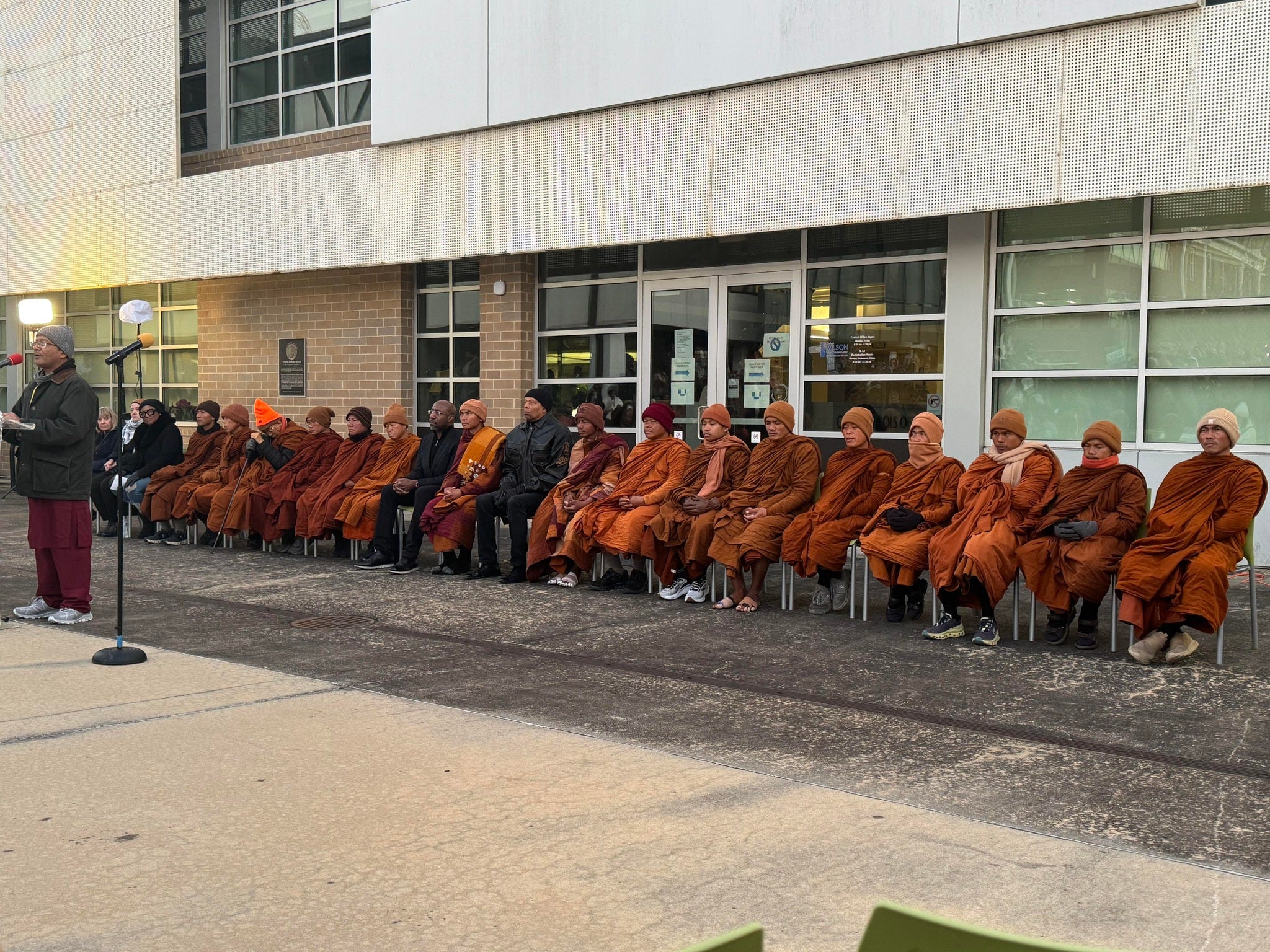
Yes, Buddhist monks walked through Decatur the other day, stopping on their 2500-mile-long trek from Fort Worth to Washington DC in an extended prayer they’ve titled “Walk For Peace.”
That is a nicely literal name. They’re trying to tell us something.
A Cheerful Way to End the Year
I walked the mile to where Decatur’s welcoming ceremony was held. A Senator, a mayor, and some county commissioners were there to greet them. It was the night before New Year’s Eve and many in the crowd of thousands were smiling despite the cold . There’s a nasty chest cold hitting a lot of people right now, so I hung in the back avoiding the dense gathering of disease vectors. I didn’t see any of the dignitaries, but I could hear everyone.
A monk came to the microphone to talk of their mission. He spoke of compassion and mindfulness—Buddhism 101. That’s post-doc level Buddhism too, but without the riddles. At its heart, Buddhism is simple, but it still requires a lot of practice. That’s what the questions are for.
Probably the most famous koan is “What’s the sound of one hand clapping?”
These riddles are not aphorisms that are meant to be taken literally. For example, I can close one hand rapidly, striking the fingers against the palm of my hand. That makes a sound. Is that the sound of one hand clapping? A Buddhist would laugh at that answer. It’s too literal.
Another famous koan is “If you see the Buddha on the road, kill him.”
They do not mean that one literally either. If you meet these monks on the road, DO NOT kill them.
This needs to be said since America has already tried once. Yes, in classic American literalism, the Walk for Peace monks were run down by a tractor-trailer somewhere outside of Houston. One of them eventually lose a leg as a result. It was an accident, not malicious. I’d like to think that the truck driver emerged from all this a little more enlightened, though.
Again, Do Not Kill The Buddha!
The monk offered a blessing. I was going to record it for you, but he asked the crowd to raise both hands to receive it. I might be a hard-hearted son-of-a-bitch, but even I understood this was not a southern “bless your heart,” but something more. I put my phone in my pocket, raised my hands above my head, and tried to take in the chant in the spirit it was offered.
He finished by inviting everyone to walk with them to Washington. “Spiritually, not literally,” he joked. He seemed to be getting the swing of things in America.
When they headed out, they walked quickly, like people who were well-practiced at it and had dinner and a warm place waiting for them at the end. There were close to a dozen police cruisers and emergency vehicles following them with their lights flashing.
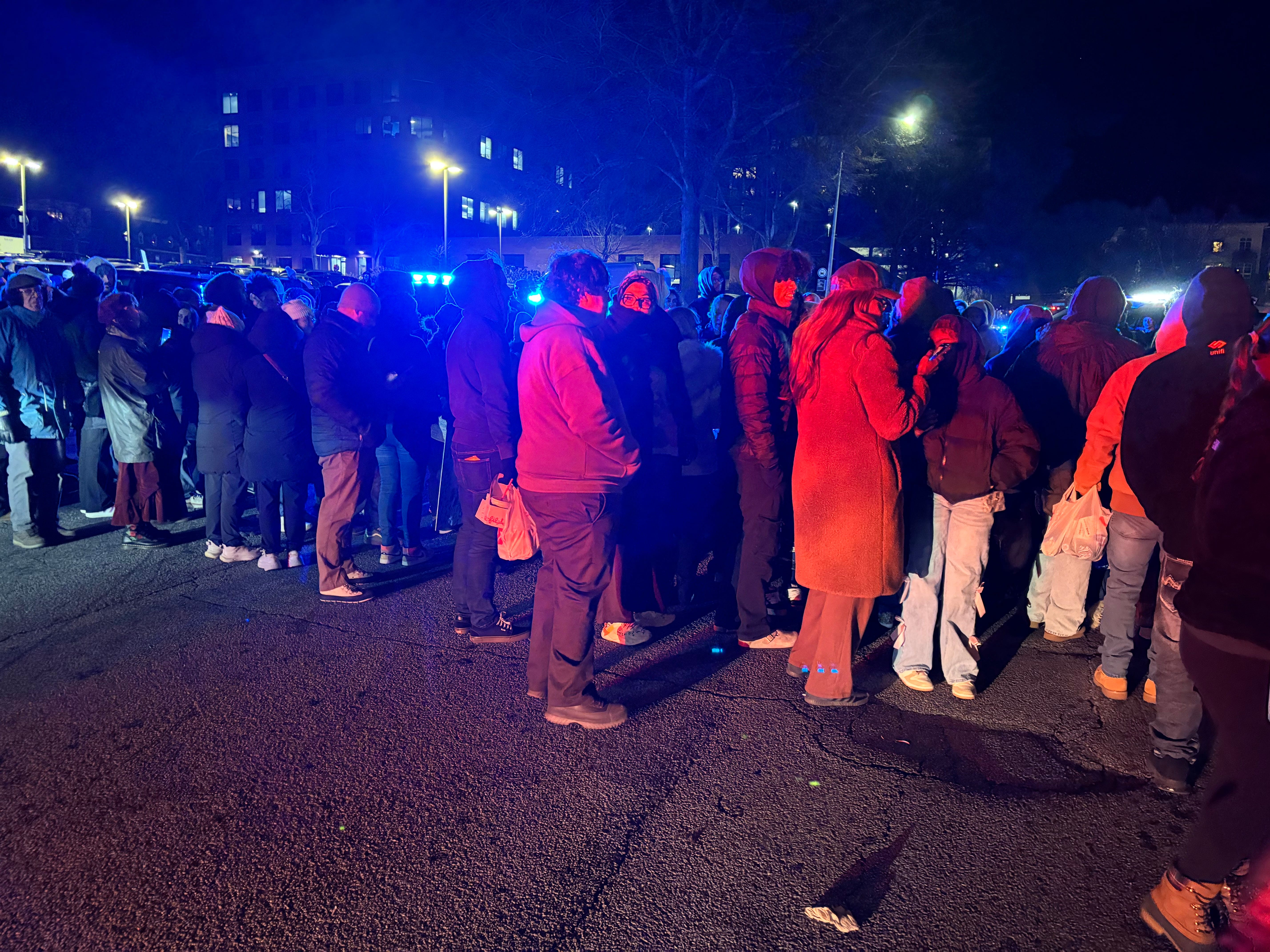
Me and a couple hundred others followed them through the town. The person in front of me wore a hoodie with “True Religion Jeans Company” printed stylishly on the back. The red and blue lights bounced off the store fronts, making the cavalcade feel like a disaster response. Say what you will about Decatur, Georgia, but this city was not going to let something happen to these men under its watch. I followed them as far as Church Street, where I turned toward home.
I barely caught a glimpse of their saffron robes the whole time. Truth be told, I didn’t try very hard. I was happy to be part of a crowd of people who were there to honor them and their message. But the flashing lights and chirping sirens were annoying the heck out of me.
What’s the sound of one man walking?
If I kept walking up Church Street, I could have stopped at the Buddhist meditation center. I’ve sat there on a few Sunday mornings absorbing the calmness and tranquility of the space. I liked the place a lot.
The monks didn’t go anywhere near it.
Of course, the monks already live in a monastery. If they needed peace and quiet, they could have stayed home. The challenge, of course, is not to find peace in peaceful places. That’s the easy part. Finding peace in the chaos? That requires post-doc Buddhism. Even at a distance, even in the flashing disaster lights, even in the harsh cold of a winter night, these monks managed to project something meaningful.
That’s what I learned in my half-mile walk in their footsteps. Imagine what I could have learned if I had followed them all the way to DC. Literally.
If I had the chance to talk with the monks, I’m not sure what I’d have to ask them. I already know what the intro level lessons are—compassion and mindfulness. If I can get a grip on those, I might be ready for a koan.
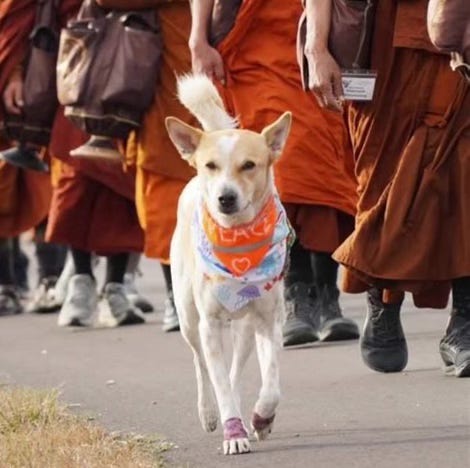
My only regret is that I completely missed Aloka, the peace dog that’s leading the walk. I would have loved to have played with Aloka.
A Note to Regular Readers
One of the reasons I launched A Clean Well-Lighted Handbasket six months ago was to reclaim the joy in the habit of writing. For me, that required a commitment to publishing weekly.
My once-a-week commitment has gotten me to the point where I look forward to writing every day. I haven’t had that for years. But sometimes, that deadline has caused me to rush a piece I should have spent more time on. That has lead to some sloppy writing and made me miss the chance to delve more deeply into something I want to say.
I read a column the other day that pointed out that AI is taking work from average writers everywhere, but great writing is still rising to the top. I’m proud of what I’ve published here. Buthe goal of every writer should be to be better, and for me that means taking more time. I want to spend more time with my thoughts, and I want to spend more time getting things right. So you’ll be hearing from me a little less. A Clean, Well-Lighted Handbasket will publish biweekly moving forward. My hope is that you will enjoy the new iteration more.
Song of the Week
The first song that came to mind this week was the Original Sins’ Kill the Buddha. The Original Sins are one of my favorite bands, but that isn’t one of their best cuts. I’ll post something from them someday.
So I did a search for Buddhism and rock songs and I came across a close Buddhist reading of Dylan’s All Along the Watchtower. That whole song feels like a koan, so I’m going with it.
Let us not talk falsely now, the hour is getting late.
In Laos I followed monks on their early- morning begging rounds, and chatted up some young ones at Angkor Wat. That way of life is definitely, uh, not the same as most Americans' piggishness. Also not as pure and simple as we outsiders like to portray it.
This post is making me re-evaluate one of my favorite lines from a Neil Young song, "I Am A Child." The line is "What is the color when black is burrrrrn-ed?" I always knew it wasn't meant to be literal; now I'm wondering if he meant it as a koan of sorts.
(Another favorite Neil line, from "The Old Laughing Lady":
"You can't have a cupboard if there ain't no wall". That's so brilliant.
I digress)
p.s. "John Wesley Harding" is probably my favorite Dylan album, if one must pick.