
Let’s get the negatives out of the way: Vienna is far away. Even by European standards, it’s far. It’s way over on the eastern end of Austria. There aren’t any direct flights from Atlanta to Vienna, and the Viennese do not hop a train to Paris for the weekend—it’s a 15-hour ride. That’s why they have those sleeper cars you see in the movies.
Okay, that’s out of the way. There’s not much more to complain about.
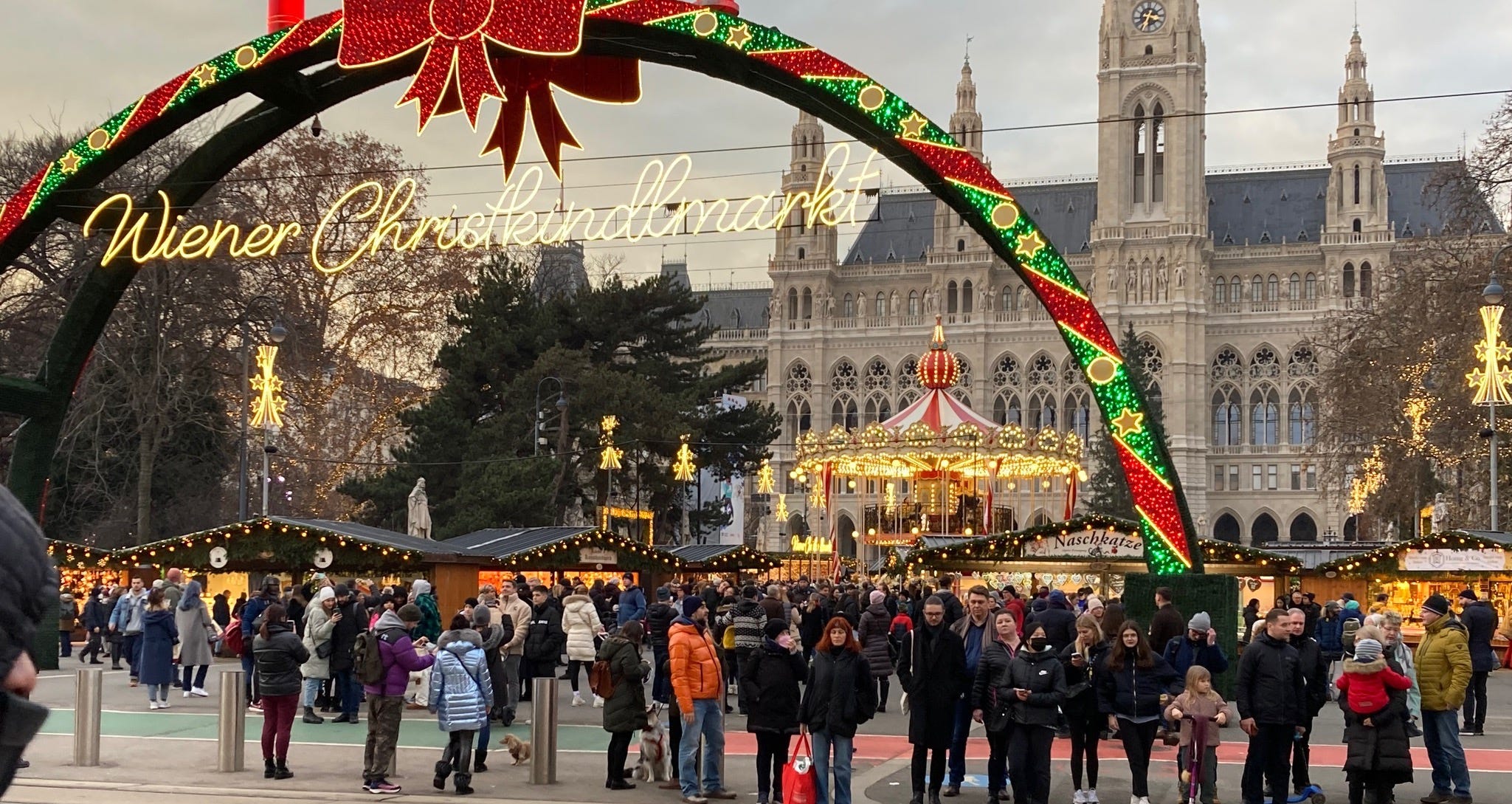
For my sixtieth birthday, I chose to go to Vienna. After many years of dreaming of Europe, I’ve been able to go regularly of late and have covered a lot of ground. And when Mi Esposa asked where I’d like to go to mark my official entry into oldness, Vienna came to mind immediately. We had already ruled it out as a retirement destination due to its distance. Still, I wanted more.
After a week on the ground, that all changed. Yes, we had a great time. But this is a city that has more to offer than a good time for tourists. Now it’s high on the list of destinations. I accept that there’s recency bias involved here, so let’s start with a more objective assessment.
What the Adults Have To Say
For several years in a row, Vienna was listed as the most livable city in the world by the Economist Intelligence Unit, a division of The Economist publication. It dropped to number two in 2025. The EIU claims that change was due to overall political instability in Europe, though I think it was because the graphics team had run out of stock photos of Vienna to put on the cover of the report. Nonetheless, it scores 97.1 out of 100 in their assessment. That ranking is based on infrastructure, healthcare, education, stability, and culture/environment.

Other European cities in the top five are Copenhagen, Zurich, and Geneva. Copenhagen is the new number one, but it wouldn’t be if the judges took seasonal affective disorder into consideration. I mean, what do you do in Copenhagen in February besides leave?
Zurich? Geneva? Vienna is about 40% cheaper to live in than those Swiss wonderlands. Surprisingly, the publication that calls itself “The Economist” doesn’t consider cost of living in its rankings of livability.
Anyway, three percent short of perfect is still pretty good.
The Retired City
Here’s my theory—Vienna is a retired CEO disguised as a city.
Don’t get me wrong, Vienna is a vital place, it’s not the sitting-on-the-porch-in-a-rocking-chair kind of retired. It’s the capital of Austria, and a major nexus for business. It’s an important medical R&D center and a leading tech hub. OPEC has a big presence as do many of the multinationals. The streets and restaurants are full of smartly dressed business people making things happen.
But it’s a city that worked hard as the seat of an empire for centuries, socked away its cultural wealth and accolades, then took its golden parachute. Now it’s living its best life, managing its retirement portfolio for the long-term, and settling into that golden time when it has health, wealth, and friends, while leaving all the drama to the youngsters.
It’s a city that gets its exercise, eats well, dresses up for the opera, has the kids home for the holidays, and enjoys life after they leave. It has everything it wants and needs, thank you very much.
So let’s run the numbers:
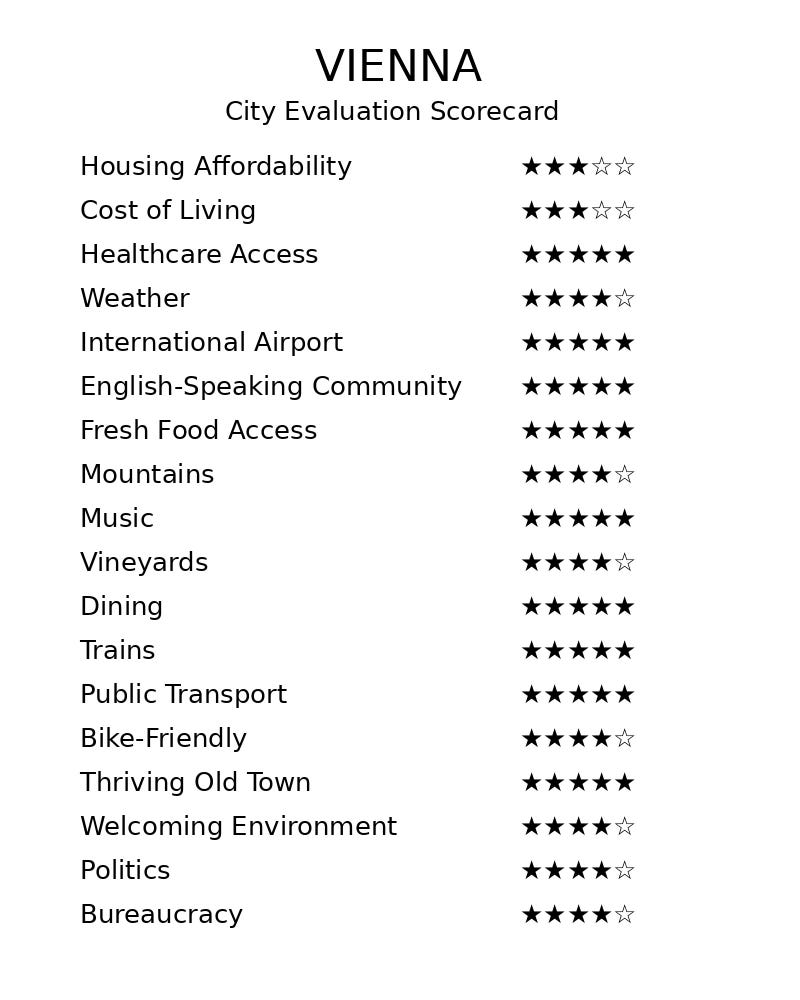
Overall Score: 4.55
That’s the second best score overall, slightly behind Freiburg. But one consideration not included in the scorecard is access to health insurance. That’s because I set up my criteria thinking we were really only looking at German destinations.
Signing up for Austria’s very good insurance program is straightforward and inexpensive. In Germany, the public health insurance program is essentially closed to new subscribers after age 55. The private insurance in Germany is better, but more expensive.
On the Ground
First off, Vienna does not want your car. It wants you walking its streets or riding its trains. The public transportation system is considered by many to be the best in the world. Residents pay 365 euros for an annual pass that gets them access to the local trains, buses, subways, and streetcars. And there’s no turnstiles or tickets involved—you just walk on and off without hassle. This is a city where living without a car might feel perfectly natural. (BTW, retirees get access to Austria’s countrywide train system for a whopping 29 euros per year.)
Vineyards, you ask? Vienna is the only capital city in the world with vineyards within the city limits. Multiple vineyards in the city itself. What does that say about its priorities?
How about mountains? Sure! This is Austria, after all. The Northern Alps are about an hour and a half away.
Thriving Altstadt? Kinda, sorta? So much of the city is pedestrian-friendly that it all feels like an old town, but the businesses aren’t so traditional and it all feels current.
English-speaking community? In spades. Healthcare? World-class and easily accessible. Fresh food? Take a walk through the Naschmarkt. Dining? Don’t get me started. Music? We’re talking about Vienna here.
Vienna is also a very safe city—with a crime index less than half of Atlanta’s. (Once they caught that Harry Lime guy, criminal activity plummeted.)
Tourists? Sure, why not?
Vienna is, of course, a big tourist town, but even the tourists feel different. A trip through Switzerland, London, or Barcelona means dodging the flood of influencers who spent their morning getting themselves made up so that they could pose in front of one iconic view or another. We saw one in the Michaelina Wautier exhibit in the Kunsthistorisches Museum, and she just looked silly. You don’t see much of that in Vienna.
Mozart don’t Instagram.
The thing about Vienna is that it is a big city, but on the ground it feels like the worst parts of being a big city have been stripped away. There’s little traffic, and the noise that comes with it is missing. Crime is low, getting around is easy, and the scale of the city itself doesn’t feel overwhelming, like New York, London, or Paris sometimes can. It’s both vital and calm. It’s a great place to visit, and it sure looks like a great place to live.
Song of the Week
Once upon a time, there were two sworn enemies born of the same mother: Bono Vox and Ultravox. But there could be only one, and so they met in a clash to the death.
They say that Ultravox fought more valiantly, but Bono Vox laid a trap that involved a lot of old-school cameras and flash bulbs in an opera house. In the end, Bono Vox emerged as the victor. The trap, however, backfired and he was blinded in the battle. Ever since, he has been forced to wear special prosthetic sunglasses in order to see, despite looking ridiculous in them.
In shame for killing his brother, Bono Vox dropped the “Vox” from his name and has gone by “Bono” ever since. Swearing that he would redeem himself , he has roamed the world, saving one starving child at a time. It was long ago, but those of us who witnessed the battle can never forget it, for it happened in Vienna. Oh, Vienna!
This story makes as much sense as this video. But I always stopped and watched it when it came on MTV in 1981.
Beautifully written Daren! Loved using the CEO metaphor! And now I want to go to Vienna!
My favorite city in the world. . .so far.